
Periodically, a handwritten list of items of furniture that we “need” mysteriously appears in a prominent place in the home with a few of the items heavily underlined, indicating some degree of urgency. Occasionally an item will pique my interest and I set about making it, however, the list is evidently endless and it could take me some years to wade through just the items that hone my edge.
In the essence of connubial accord though, I thought I would commit to a few of the items on the list (which I will update as the notion takes me) and so, in no particular order:
* An outstanding George II walnut serpentine chest of drawers comprising a caddy-top, serpentine front, dressing slide, canted and blind-fretted corners, ogee bracket feet, feather- and cross-banded top and drawers, with original brasses. (Completed)
 George II walnut serpentine chest, circa 1750-60. (Christie’s)
* A spectacular ash chest-on-stand, with bold crossbanded and featherbanded drawers, standing on turned legs united by a wavy stretcher. (Completed)
 William III ash chest-on-stand, circa 1700, the brasses replaced. (Robert Young)
* A superb Queen Anne walnut cabinet with moulded arched cornice flanked by urn finials to either side above an arched door inset with a bevelled mirror plate and enclosing three shelves, a short drawer and two pigeon holes, on a moulded plinth base.
 Queen Anne walnut mural corner cabinet, circa 1710. (Bonhams)
* An early George III mahogany blanket chest with a hinged lid above two dummy drawers and two functional drawers.
 George III mahogany blanket chest, circa 1765. (Christie’s)
* A pair of mid-eighteenth-century Irish red walnut side chairs with stuffover seats (completed).
* A fine and rare George I walnut armchair, with shepherd’s crook arms. The cabriole front legs and splayed rear legs joined by a shaped stretcher.
 George I walnut armchair, circa 1715. (Mackinnon Fine Furniture)
*A mahogany silver chest on cabriole legs.

George II silver chest, circa 1740. (Solomon Bly)
* A mid eighteenth-century Virginia walnut chest of drawers (Completed).
 George II walnut chest of drawers, circa 1755. (Christie’s)
* A late seventeenth-century William and Mary simulated tortoiseshell (later japanned) chest of drawers with silvered handles. (Completed)
 William and Mary simulated tortoiseshell chest of drawers, circa 1695. (Christie’s)
* A late eighteenth-century mahogany kneehole desk with leather writing surface. (Completed)
 A George III mahogany kneehole desk, circa 1770. (Christie’s)
* A George III mahogany cabinet-on-chest, with dentil and fluted cornice. (Completed)
 Chippendale mahogany cabinet-on-chest, circa 1775. (Christie’s)
* A small wooden box or caddy in which to secrete daily medications… and chocolate! (Completed)
* A late eighteenth-century mahogany canterbury with turned spindles (I’m not yet one hundred per cent sold on the turned spindles), on square tapered legs and square socket castors.
 A George III mahogany canterbury, circa 1790. (Mallett)
* A walnut (or elm) mural corner cupboard with cross-veneered, arched fielded door. (Completed)
 George II walnut mural corner cupboard, circa 1730. (Wakelin & Linfield)
* A very smart little Queen Anne elm gateleg table with gun-barrel-turned legs and braganza feet. (Completed)
 Queen Anne gateleg table circa 1710. (Robert Young)
* A George II burr elm bombé commode standing on short cabriole legs.
 A George II burr elm bombé commode, circa 1740. (Sotheby’s)
* A mahogany mural corner cupboard with rectangular fielded door and blind fretwork canted sides.
 George III mahogany mural corner cupboard, circa 1760. (Thomas Coulborn & Sons)
* A number of George III turned drupaceous fruitwood coasters in drinking glass and decanter sizes.
 A nicely patinated George III turned fruitwood coaster.
* A circa 1730 George II tripod table. This one is an unusually early mahogany example; walnut being the norm for this style and period. A mixture of walnut and yew is another possibility as evidence to hand supports the use of these woods for a virtually identical table.
 George II mahogany tripod table, circa 1730. (M. Ford Creech)
* A circa 1690 William and Mary walnut chest-on-stand, the cup-and-cover legs joined by a wavy stretcher.
 William and Mary walnut chest-on-stand, circa 1690. (Richard Gardner Antiques)
*A circa 1690 William and Mary olive oyster chest of drawers, in the manner of Hugh Granger.[i]
 William and Mary olive oyster chest of drawers, circa 1690. (Richard Gardner Antiques)
* A circa 1695 William and Mary walnut crossbanded chest of drawers. (Completed)
 William and Mary walnut chest of drawers, circa 1695. (M. Ford Creech)
* A circa 1760 George III set of eight Irish ladderback dining chairs (the original set of eight mahogany chairs supplied to the fifth Earl of Antrim for Glenarm Castle, County Antrim, Northern Ireland).
 Irish mahogany pierced ladderback chair, circa 1760. (James Fennell)
* A circa 1790 George III mahogany break-front bookcase. (Image to follow)
* A circa 1700 Queen Anne Virginia (black) walnut or fruitwood dining table. (Image to follow)
* A circa 1735 George II walnut fretted and cushion-moulded mirror of unusually small proportions. (Completed)
 Unusually small George II walnut mirror, circa 1735.
* A circa 1740 George II Irish solid elm dressing table, with cabriole legs (from sketches I made of the original – purportedly from Powerscourt House, County Wicklow). (Completed)
* A pair of circa 1745 George II walnut girandoles with brass candle branches. (Completed)
 George II walnut girandole, circa 1745.
* A circa 1745 George II walnut ladderback chair with rush seat by celebrated early eighteenth-century cabinetmaker, Giles Grendy. (Completed)
 George II walnut ladderback chair, circa 1745. (Geffrye Museum, London)
* A circa 1720 George I walnut side table, the top with re-entrant corners, over one long and two short drawers, standing on cabriole legs. (Completed)
 George I walnut side table, circa 1720. (Christie’s)
* Circa 1765 Chinese Chippendale mahogany open fret hanging wall shelves with two drawers. (Completed)
 Hanging wall shelves. (Chippendale’s Director, Plate CXII, circa 1754)
* A circa 1755 George II mahogany reader’s companion, having shaped sides and back supporting a single shelf, the sides with carrying hand holes and drawers over a plain convex apron and standing on four cabriole legs. (Completed)
 George II mahogany readers companion, circa 1755.
* A circa 1690 William and Mary yew stool with stuff-over seat, on columnar turned legs connected by moulded stretchers. (Completed)
 William and Mary upholstered yew stool, circa 1690. (Jayne Thompson)
* A George II walnut dressing glass with carved and gilded slip and original fretted crest.
 George II walnut dressing glass circa 1730. (Richard Gardner)
* A late seventeenth-century Anglo-Dutch chest of drawers, veneered in rhombi parquetry employing three different wood species – fruitwood, sycamore and padouk. The banding, mouldings and feet are also of padouk.
 William and Mary Anglo-Dutch rhombi parquetry chest of drawers, circa 1690.
* A mahogany Gainsborough chair, covered in green silk damask and close-nailed. Based on the chair in Johann Zoffany’s portrait of King George III.
 King George III, by Johann Zoffany, circa 1771.
* A late George II solid mahogany chest on bracket feet.
 George II mahogany chest, circa 1755.
* An early George III elm, ash and fruitwood double bow Windsor chair bearing traces of original paint. (Completed)
 Elm, ash and fruitwood double bow Windsor chair, circa 1760.
* A set of six Claremont fan-back Windsor chairs (named after a set made circa 1773 for Claremont in Surrey – the home of Lord Clive of India – bearing the inscription ‘Garden Chairs from Claremont’). (Completed)
 Ash, elm and walnut Claremont fan-back (legs reduced), circa 1730.
* A Mid-eighteenth-century bureau in solid English Ash with a sloping fall concealing a fitted interior, over four long drawers and standing on bracket feet. (Completed)
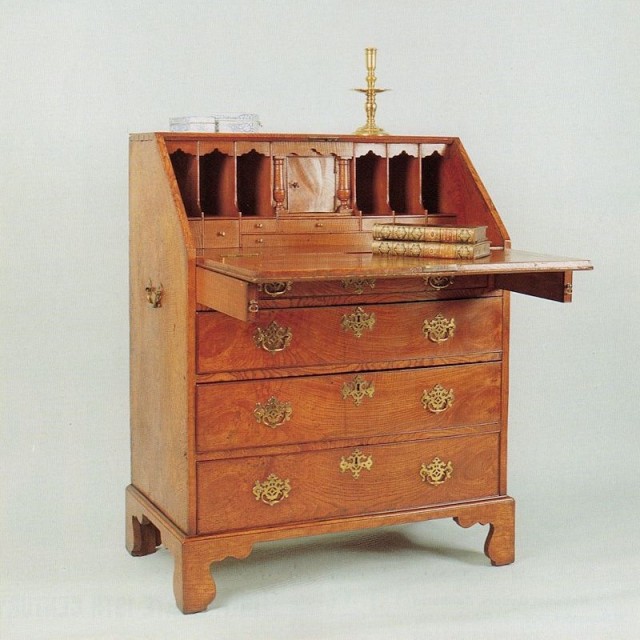 Solid ash bureau, circa 1755.
* A George I walnut-veneered inverted breakfront chest of drawers, with three short drawers over three long drawers, standing on bracket feet.
 Walnut inverted breakfront chest of drawers, circa 1720. (Dreweatts)
* A pair of George II moulded and shaped walnut girandoles with twin branch candle arms.

Walnut girandole, circa 1730. (Bonhams)
* A simple, late Georgian Irish sideboard in elm with bead-moulded drawers and typically Irish decoration to lower edge of frieze.

George III Irish elm sideboard, circa 1790.
* A series of ebony and/or black-stained sycamore (Acer pseudoplatanus), field maple (Acer campestre) or pear (Pyrus communis) ‘waved’ mirror and picture frames. The waved mouldings will necessitate the construction of a ‘waving engine’.
 Waved ebony frame, circa 1690.
 Waving engine, Joseph Moxon, circa 1694.
[i] Pictorial Dictionary of Marked London Furniture, Christopher Gilbert, W.S. Maney & Son Ltd., 1996, p.234.
 Pegs and 'Tails
Looks like you’re in this for the long haul.
LikeLike
Oh, longer than you might think. I added my own coffin to the list and the next time I looked, it had been crossed out!
LikeLiked by 1 person
…that’s funny. Very amusing.
LikeLiked by 1 person
Thank you for sharing your knowledge and thank you very much for not taking us through every mortise and dovetail. I am anxiously watching for your next project.
LikeLike
Thank you, for all your information I am currently studying to get my certification in antiques, it is a thrill but my gosh you just educated with me with so much more wow, I love it!
LikeLike
Just found your blog – excellent read so far and yes I like the areas you choose to focus and expand upon…let the others tell me tails or pins first
LikeLike
This is all fascinating, but I can’t help but wonder how big your house is?
LikeLike
Our house isn’t palatial, but I regularly bequeath furniture to make room for new arrivals.
JP
LikeLike
Pingback: Fine English Furniture at Bonhams | Pegs and 'Tails
Pingback: Season’s Bleatings | Pegs and 'Tails
Hi, I’ve only just discovered your work and have a question regarding the William and Mary Oyster chest that was on your “to-do” list, from years ago.
You list the wood as Olive. I think that would be the Oyster veneer. (?)
But what wood species do you think was used, in your experience, for the cross banding, and circular patterns on top?
LikeLiked by 1 person
All the veneer is olive; the oysters are from small diameter branches and display the dark heartwood. The banding is also olive, but is from the much paler sapwood.
JP
LikeLike
This is now one of my favorite pages. I’m slowly working through the projects — makes me sad thinking about what your book might have been like!
The end-grain banding really adds a dimension/texture to the designs. I admit that I’m surprised it has survived so well on the old furniture. Any particular tricks to maximize the longevity of furniture with these elements? Perhaps the oil/varnish/shellac provides some resiliency that I don’t appreciate?
LikeLike
The banding (and early mouldings) are cross-grain, not end-grain – there are significant differences in performance and appearance.
Being cross-grain, the banding is no more susceptible to the ravages of time than other veneers.
JP
LikeLike
Ah, cross-grain. Makes sense.
Of course, that’s what you originally wrote. Sorry that my eyes/brain substituted end-grain.
LikeLike