
It looks like that Orson Cart has been playing with his caravan again.
Jack Plane
It looks like that Orson Cart has been playing with his caravan again.
Jack Plane
Following the conclusion of Woolley and Wallis’ recent auction, lot 17, the William and Mary olivewood and marquetry chest, realised £18,900 (AUD 36,567; USD 23,543).
Lot 23, the small George II walnut gate-leg table, made £1,071 (AUD2,072; USD1,334).
Lot 57, the William and Mary walnut bureau bookcase, made £9,450 (AUD18,286; USD11,771).
Lot 135, the George II painted stick back Windsor armchair, was seemingly passed in.
All plus buyer’s premium.
Jack Plane
Woolley and Wallis’ upcoming Collections & Fine Furniture sale will take place at Dinton Hall, Buckinghamshire, on Tuesday 16th April 2024.
“The sale will comprise of over eighty lots of fine furniture and works of art which has been collected by the vendor over the last forty years, highlights include a beautiful William and Mary olivewood and marquetry chest (lot 17, estimate £10,000 – £15,000) and a William and Mary walnut bureau bookcase (lot 57, estimate £5,000 – £10,000).”
A number of additional lots caught my eye; lot 23, a small George II gate-leg table (figure 1) with an estimate of GBP800 – GBP1,200 (AUD1,531 – AUD2,296, USD1,014 – USD1,522).

Fig. 1. George II (red) walnut gate-leg table, circa 1730-40. (Woolley & Wallis)
Also, lot 135, a George II painted stick back Windsor armchair (figure 2) with an estimate of GBP800 – GBP1,200 (AUD1,531 – AUD2,296, USD1,014 – USD1,522).

Fig. 2. Ash and elm stick back armchair with original paint, circa 1800. (Woolley & Wallis)
Jack Plane
The exhibition, ‘Part of the Furniture: The Library of John Bedford‘, which runs until 2nd December 2024, is focused on the library of furniture history, assembled by former antique dealer, John Bedford (1941-2019).

University of Leeds
The exhibition explores the history of furniture as a subject, highlighting the role that books and publications have played in the evolving discourse, and directing attention to the influential role that antique dealers and collectors have played in the formation of furniture history. It is full of rare and wonderful books and manuscripts, from an early 18th century Apprenticeship Indenture, and a unique copy of Jacques Androuet Du Cerceau’s Furniture Designs (c.1545-1565), to key texts such as Chippendale’s Director (1754) and Sheraton and Hepplewhite pattern books.
The exhibition is free to visit – the Treasures Gallery is open Tuesday to Friday 10am-5pm – and runs from 9th January until 2nd December 2024. Do also keep your eyes open for events associated with the exhibition ‘Part of the Furniture: the John Bedford Library’ throughout 2024.
Jack Plane
Cheers to everyone who took the time to read my posts over the past year, and a special thank you to those who commented on them.

Wishing everyone happiness, health and prosperity in 2024.
Jack Plane
Whatever your persuasion and situation, I wish you all well during the festive season.

John Massey Wright, The Ghost. – A Christmas Frolic, circa 1814.
Jack Plane
The upcoming Furniture, Works of Art and Clocks sale will take place over two days at Woolley and Wallis’ Old Sarum Galleries, commencing on Wednesday 17th January 2024.
“The January auction has over 800 lots of fine period furniture, treen, sculpture, Grand Tour works of art, lighting, carpets and collectable items. Day 1 (lots 1-379) on Wednesday 17th January 2024 includes: the Simon Castle Collection of Treen, with some wonderful pieces including: a Charles II lignum vitae wassail bowl (102) and some good Black Forest carvings of mountain dogs (117 & 117A) and an eagle in the manner of Alfred Stahli (124). Other highlights of Day 1 include: a pair of eagle console tables after Francis Brodie (209), a fine pair of George III blue john obelisks (250), a French Empire ormolu ‘Harlequin’ clock (329) and a William and Mary walnut and marquetry longcase clock by Joseph Windmills (312)”.
A number of additional lots caught my eye, a George III faux tortoiseshell table cabinet (lot 73a), which, from this distance, I am not convinced is faux – I’m sure I can see the edges of the tortoiseshell veneer, especially around the door edges (figure 1).

Fig. 1. George III faux tortoiseshell table cabinet. (Woolley & Wallis)
A George II mahogany serpentine commode on stand (lot 189) with finely shaped legs (figure 2).

Fig. 2. Mid-eighteenth-century mahogany commode. (Woolley & Wallis)
A George III mahogany serpentine kneehole desk (lot 217). The blind frets and ogee bracket feet are welcome features (figure 3).

Fig. 3. George III mahogany kneehole desk, circa 1770. (Woolley & Wallis)
Jack Plane
Following the conclusion of Woolley and Wallis’ recent auction, lot 266, the George I burr walnut secretaire chest-on-chest, rose slightly above their pre-auction estimate of GBP3,000 – GBP4,000 (AUD5,728 – AUD7,638; USD3,689 – USD4,919), selling for GBP4,200 (AUD8,019; USD5,166).
Plus buyer’s premium.
Jack Plane
The upcoming Furniture, Works of Art and Clocks sale will take place over two days at Woolley and Wallis’ Old Sarum Galleries, commencing on Wednesday 4th October 2023.
As usual, there is a good selection of quality lots on offer, one of which – a George I burr walnut secretaire chest-on-chest (lot 266) – caught my eye (figure 1).

Fig. 1. A very presentable secretaire chest. (Woolley & Wallis)
Burr walnut secretaire chests-on-chests aren’t exactly rare; however, this example has unusual handles (figure 2). The bails are so good, I can almost believe they are original, despite a few unsettling scratches on a drawer front (figure 3). If a reader happens to view or purchase this lot, please let me know if they are nineteenth-century additions).

Fig. 2. Carved wooden bail. (Woolley & Wallis)

Fig. 3. Petal-shaped terminal – and scratches. (Woolley & Wallis)
Jack Plane
Following the conclusion of Woolley and Wallis’ recent auction, Lot 35, the George II mahogany bureau cabinet, rose a little above their estimate of GBP400 – GBP600 (AUD744 – AUD1,115; USD506 – USD758), realising GBP700 (AUD1,344; USD 891)
The yew and elm comb back Windsor armchair, Lot 229, didn’t quite reach their pre-auction estimate of GBP1,000 – GBP1,500 (AUD1,858 – AUD 2,787; USD 1,264 – USD 1,896), selling for only GBP900 (AUD1,729; USD 1,146.
All plus buyer’s premium.
Jack Plane
Following the conclusion of Bonhams furniture auction, Lot 74, the George II mahogany card table, realised GBP2,304 (AUD4,410, USD2,911) plus buyer’s premium.
Lot 104, the George III mahogany serpentine commode, and Lot 117, the George III mahogany open armchair appear to have been passed in.
Jack Plane
The upcoming sale, Collections, Including Selected Items From The Estate of Lord Eden of Winton, will take place at Bonhams, Knightsbridge on Wednesday 28th of June 2023.
There are some splendid lots on offer, a few of which caught my eye: Lot 74, is a George II plum pudding mahogany card table with a pre-auction estimate of GBP2,000 – GBP3,000 (AUD3,716 – AUD5,573; USD2,556 – USD3,835).

Lot 74, a George II plum pudding mahogany card table, circa 1750. (Bonhams)
Lot 104 is a George III mahogany serpentine commode, attributed to Ince and Mayhew with a pre-auction estimate of GBP8,000 – GBP10,000 (AUD14,867 – AUD18,585; USD10,226 – USD12,782).

Lot 104, a George III mahogany serpentine commode, circa 1780. (Bonhams)
Lot 117 is a George III mahogany open armchair in the manner of Wright and Elwick with a pre-auction estimate of GBP4,000 – GBP6,000 (AUD7,435 – AUD11,152; USD5,113 – USD7,670).

Lot 117, a George III mahogany open armchair, circa 1760. (Bonhams)
Jack Plane
The upcoming Furniture, Works of Art and Clocks two-day sale will take place at Woolley and Wallis’ Old Sarum Galleries, beginning on Wednesday 5th July 2023.
There are numerous fine lots on offer, a few of which piqued my interest: Lot 35, is an unusual George II mahogany bureau cabinet with a pre-auction estimate of GBP400 – GBP600 (AUD744 – AUD1,115; USD506 – USD758).

Lot 35, a George II mahogany bureau cabinet, circa 1740-50. (Woolley and Wallis)
And Lot 229 is a yew and elm comb back Windsor armchair with front cabriole legs united by a crinoline stretcher. It carries a pre-auction estimate of GBP1,000 – GBP1,500 (AUD1,858 – AUD 2,787; USD 1,264 – USD 1,896).

Lot 229, a George III yew and elm comb back Windsor armchair. (Woolley and Wallis)
Jack Plane
That Orson Cart chap is tinkering again here!
Jack Plane

Not all bunnies come bearing chocolate. Natheless, happy Easter one and all.
Jack Plane
Following the conclusion of Woolley and Wallis’ recent auction, a set of George III Chippendale style padouk hanging shelves (lot 217) rose well above their estimate of GBP2,000 – GBP3,000 (AUD 3,725 – AUD5,588; USD2,490 – USD3,734), realising GBP10,000 (AUD18,629; USD 12,448) – plus buyer’s premium.
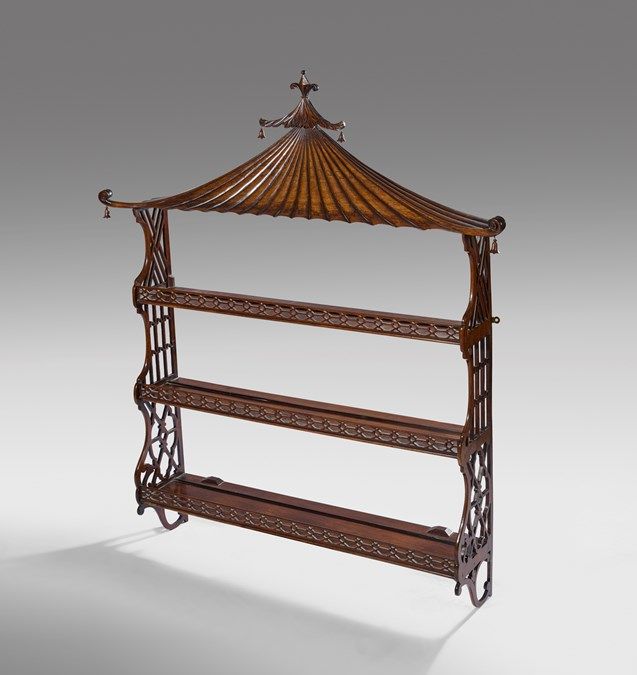
George III padouk hanging shelves, circa 1770. (Woolley and Wallis)
Jack Plane
Regular readers of this blog would be familiar with the furniture, silver and porcelain associated with serving and partaking of tea during the seventeenth-, eighteenth- and nineteenth-centuries, but many may not be aware of the fervor behind the fashionable drink.
China has a long history of cultivating and drinking tea dating back almost 3,000 years. The leaves of Camellia sinensis, a medium-sized evergreen shrub, are harvested and processed in a variety of ways to produce leaf tea.
In 1625, the trader Samuel Purchas, wrote how the Chinese prepared “… the powder of a certaine herbe called chia of which they put as much as a walnut shell may contain, into a dish of Porcelane, and drink it with hot water“.
Traders in the mid-seventeenth-century brought such teas as Bohea, Pekoe and Congo to Britain from the Chinese ports of Canton and Shanghai. The darker teas, Bohea and Pekoe, were considered the best varieties and Congo somewhat less so. Green tea was considered inferior and therefore cheaper. Of the green teas, Hyson (named after the first merchant of the East India Company to import tea into Britain) enjoyed broad popularity. The East India Company received their first shipment of tea (amounting to 143 pounds – 65 kilos) from their agent in Bantam in 1669.
In seventeenth-century North America, traders first introduced tea to the Dutch settlers in New Amsterdam however, it wasn’t initially too well received: “Some tried to serve it like spinach with salt and butter, others ate it on toasted bread”. [i]
Worse was still to befall the colonists.
Meanwhile in England, tea-drinking defined respectability amongst the aristocracy, spurring the importation and manufacture of all manner of tea paraphernalia. Chinese tea wares – essential to the ritual of drinking tea – were simultaneously imported along with tea. However, the cost of Chinese porcelain (figure 1) was colossally expensive, but English porcelain factories like Chelsea (fig.2), Worcester (figure 3), New Hall et al answered to the demand and produced delightful interpretations at a fraction of the price.

Fig. 1. Jean-Etienne Liotard, Still Life: Tea Set, circa 1783.

Fig.2. Chelsea tea service, circa 1755. (Brian Haughton Gallery)

Fig.3. Early Worcester octagonal Red Bull tea bowl, circa 1754. (Leslie Antiques)

Fig. 4. New Hall Teapot, circa 1782-87. (Juno Antiques)
Many forms of tea tables (fig. 5) and tea caddies (fig. 6) also proliferated.

Fig. 5. George II walnut tea table, circa 1740.

Fig. 6. George II burr oak tea caddy, circa 1740-50.
At its introduction, tea was prohibitively expensive to all but the gentility, due largely to the East India Company’s monopoly of the commodity and the Government’s high taxes on its importation.

Fig. 7. Joseph Van Aken, A Tea Party, circa 1720.

Fig. 8. Johann Zoffany, The Garden at Hampton House with Mr. and Mrs. David Garrick taking tea, circa 1762.
As is the world though, tea soon found its way onto the black market, making it affordable for the everyday man (figure 9).

Fig. 9. William Redmore Bigg, A Cottage Interior: An Old Woman Preparing Tea, circa 1730.
By the 1770s, all foreign tea had to be first imported into London by registered merchants to be levied before distribution to domestic and foreign markets. Several popular means of circumventing taxation were adopted by enterprising individuals: Genuine tea was frequently adulterated by the addition of various domestic tree buds including those of the ash, elder and hawthorn along with innumerable herbs and sheep faeces. Chamomile was an important addition in teas preferred by British women. Great fields of the stuff were grown in the South West of the country and harvested by specialized horse-drawn cutters (fig 10).

Fig. 10. Chamomile cutter along with a set of leather horse boots to help protect the valuable crop.
It was these exports of toxic and adulterated tea – as much as extortionately high taxes – to the North American colony that ultimately resulted in the Sons of Liberty (disguised as Mohawk Indians) boarding three ships in Boston Harbour and throwing 92,000 pounds of tea overboard in 1773.
Smuggling tea into Britain avoided the cripplingly high taxes and accounted for approximately 34% of domestic consumption. The practice flourished to the extent one commentator declared so many people were employed in smuggling that the country’s agriculture was suffering as a consequence.

Fig. 11. Giles Grinagain (pseud.), Loading A Smuggler.

Fig. 12. Thomas Rowlandson, Rigging Out a Smuggler.
The arse eventually fell out of the illegal tea trade in 1784 with the introduction of the Commutation Act, which slashed the tax on tea from 119% to 12.5%. Consequently, many former smugglers, with an intimate understanding of the tea trade, themselves, became bona fide tea merchants.
Jack Plane
[i] Israel, Andrea. Taking Tea. (New York: Weidenfeld & Nicolson, 1987.
Christopher Storb has just posted a well-illustrated monograph on the unseen, hastily prepared secondary surfaces of furniture and architectural woodwork.
Jack Plane
Cheers to everyone who took the time to read my posts over the past year, and a special thank you to those who commented on them.

Wishing everyone happiness, health and prosperity in 2023.
Jack Plane
Whatever your persuasion and situation, I wish you all well during the festive season.

Robert Cruikshank, High Life Below Stairs, circa 1825.
Jack Plane

Trade card of carpenters, Benjamin and John Osgood, possibly between 1811 and 1820. (Lewis Walpole Library)
Benjamin & John Osgood carpenters, at the Rising Sun by London Stone in Cannon Street, perform all sorts of carpenters work; survey and measure land, and all kinds of work, & draw accurate plans &c. They also furnish funerals to any part of Grt. Britain &c.
NB. A convenient house for publick or private funerals.
Jack Plane
Hugh Roberts and Charles Cator, Industry and Ingenuity: The Partnership of William Ince and John Mayhew (London: Philip Wilson Publishers, November 2022), 448 pages, ISBN: 9781781301098. Via Bloomsbury.

The first comprehensive study of William Ince and John Mayhew’s famous eighteenth-century cabinetmaking partnership, complemented by high-quality photographs of their work.
The partnership of William Ince (1737–1804) and John Mayhew (1736–1811) ran from 1758 to 1804 and was one of the most enduring and well-connected collaborations in Georgian London’s tight-knit cabinetmaking community. The partners’ clientele was probably larger, and their work was arguably more influential over a longer period, than most other leading metropolitan makers – perhaps even than that of their older contemporary, the celebrated Thomas Chippendale.
Despite their considerable output and an impressive tally of clients and commissions, much of Ince and Mayhew’s work has remained unidentified until recent times. The authors’ substantial research in private family archives, county record offices and bank archives has allowed them to uncover much new evidence about the business and its influence within cabinetmaking circles. In Industry and Ingenuity, the results of these new investigations are presented alongside an impressive selection of more than 500 colourful, vibrant photographs of Ince and Mayhew’s works, many previously unpublished, which together emphasise the partnership’s proper position in the pantheon of great eighteenth-century cabinetmakers.
Table of Contents
PREFACE
PART ONE: THE BUSINESS
Apprenticeship and Partnership
Premises and Family
Role of the Partners
The Universal System of Household Furniture
Branches of the Business
Workshop Management
Accounting and Finance
Clientele
Relationship with Architects
‘House Style’ and Stylistic Development
Dissolution of the Partnership
The Suit in Chancery
PART TWO: COMMISSIONS
Documented Commissions
Possible Commissions
PART THREE: ILLUSTRATIONS
Select Bibliography (with Abbreviations)
Photographic Credits
Acknowledgements
Index
Jack Plane
I just noticed that daydreamer Orson Cart has posted another bulletin here.
Jack Plane
If remotely interested, you can read the latest from Orson Cart here.
Jack Plane
All right sleuths; let’s be having your opinions again please.

Fig. 1. (Box House)

Fig. 2. (Box House)

Fig. 3. (Box House)

Fig. 4. (Box House)

Fig. 5. (Box House)

Fig. 6. (Box House)
As per usual, I may withhold some early comments for a short period to let others have a stab at it.
Jack Plane
The George II mahogany desk (lot 256) mentioned in Woolley and Wallis’ recent auction realised GBP1,000 (AUD1,764; USD1,217).
The pair of Irish-style Chinese export padouk elbow chairs (lot 526) realised the lower estimate of GBP15,000 (AUD26,460; USD18,249).
All plus buyer’s premiums.
Jack Plane
The upcoming Furniture, Works of Art and Clocks two-day sale will take place at Woolley and Wallis’ rooms at 51-61 Castle Street, Salisbury, Wiltshire, on Wednesday, 29th June and Thursday 30th June 2022.
There are many fine lots on offer, and a few piqued my interest: Lot 256 is a rather elegant George II mahogany desk with a very fair pre-auction estimate of GBP500 – GBP800 (AUD873 – AUD1,398; USD629 – USD1,006).

Lot 256, a George II mahogany desk, circa 1740. (Woolley and Wallis)
The top billing is lot 526, an extraordinarily fine pair of Irish-style Chinese export padouk elbow chairs (with a somewhat ambiguous Catalogue Note), carrying a pre-auction estimate of GBP15,000 – GBP20,000 (AUD26,197 – AUD34,922; USD18,861 – USD25,148).

Lot 526, A pair of George III Chinese export padouk chairs, circa 1760. (Woolley and Wallis)
Jack Plane
Another communiqué from Orson Cart here.
Jack Plane
Roll on Cross Bun Day!
JP
As it is approaching Good Friday I thought I would share some information about the original Chelsea Bun House. Easter is traditionally the time for hot cross buns which are slightly different to Chelsea buns as the Chelsea bun is made of a rich yeast dough flavoured with lemon peel, cinnamon or mixed spice and are much sweeter and stickier than hot cross buns.
The Chelsea Bun House is believed to have originated in the early 1700s and was run by the same family for over 100 years, producing what we still know today as Chelsea Buns, although the recipe may have changed slightly over the centuries to cater for modern tastes.
The shop was owned by the Hand family and for some considerable time was run by Richard and Margaret Hand. Richard died in 1767 leaving the business to his second wife, Margaret. The couple raised two sons, but…
View original post 688 more words
If at all possible, take yourself along to see this exhibition: You’ll talk about it for the rest of your days!
JP
The harlequin table (Lot 129) mentioned in Woolley and Wallis’ recent auction in Salisbury, Wiltshire, realised GBP900 (AUD1,582; USD1,182).
The pine cabinet maker’s tool chest (lot 159) realised GBP750 (AUD1,318; USD985) – somewhat less than its lower pre-auction estimate of GBP800.
All plus buyer’s premiums.
Jack Plane
The entrance halls of some of the great English houses of the affluent could oft be places of unbridled conviviality, or conversely, dens of apprehension, abasement, and even injury.
In a time when an Englishman’s home was his castle, uninvited visitors were strongly frowned upon. Visiting cards became an indispensable tool of etiquette, with sophisticated rules governing their use.
The essential convention was that a first person would not expect to see a second person in the second’s own home (unless previously introduced and invited) without having first left his visiting card at the second’s home. Upon leaving the card, the first would not expect to be admitted initially but instead might receive a card at his own home in response from the second. This would serve as a signal that a personal visit and meeting at home would be welcome. On the other hand, if no card was forthcoming, or if a card was sent, sealed in an envelope, a personal visit was thereby discouraged.
The whole song and dance routine depended upon there being servants to open doors and receive the cards and was, therefore, confined to the social classes who employed servants.[i]
The exception might be trades people offering their business flyers (figures 1, 2, 3, 4 & 5), in the hopes of patronage.

Fig. 1. Flyer of John Hinge, ‘operator for corns and nails’.

Fig. 2. Flyer of John Brailsford, cutler.

Fig. 3. Flyer of William Woodward, nightman.

Fig. 4. Flyer of Thomas Hedges, comb and brush maker.

Fig. 5. Flyer of Benjamin Tiffin, bug-destroyer.
Once admitted into the house by the butler, visitors, of all ranks, were requested to wait in the hall while the butler went and sought the pertinent inhabitant. Callers of quality, assured of an audience, would merely pace the stone or marble floor for a few moments until being received, while most vendors and service providers would be told to sit on one of the solid, exacting, chairs that were positioned round the walls. Hall chairs (figure 6) were intentionally uncomfortable; designed to intimidate tradespeople, potential suitors, and other uninvited callers.

Fig. 6. Mahogany hall chair, circa 1825. (Thakeham Furniture)
Butlers would often receive perquisites from certain unsolicited callers, but ultimately, were responsible for conducting a well-oiled house. If confronted with some repugnant or fainéant individual upon opening the front door, the caller might well have been unceremoniously dragged inside, held down on one of the hall chairs and treated to an horrific ordeal with a leg clamp to ensure their non-return.
Such was the case with one Bernard ‘Bernie’ Clay (figure 7), a London brick dust seller, intent solely on equipping the household with the necessary brick dust to polish their mahogany.

Fig. 7. Bernie Clay, brick dust seller.
The butler concerned, one Percival Leftlegs, took exception to Clay, admitted him, and then summoned a few accomplices to deal with him. Clay was constrained in a hall chair and set about by Leftlegs who applied a leg clamp to the unfortunate’s right leg (figure 8).

A. Bernie Clay. B. Sebastian Bellmouth.
C. Percival Leftlegs. D. Bellmouth’s brother-in-law.
Fig. 8. Bernie Clay being coerced.
History does not relate whether Bernard Clay suffered lasting physical or mental impairment, nor if he ever returned to the same premises.
A more satisfactory outcome, under similar circumstances, was achieved by Edward Rhododendron, a gardener from a large estate near Dulwich who sought counsel with his master to apply for the vacant position of head gardener.
An overzealous butler caused sever bruising and lacerations to Rhododendron’s right leg, but the unsavoury incident came to the attention of the estate owner, who indeed, granted Rhododendron the hallowed position of head gardener (figure 9).

Fig. 9. Edward Rhododendron, with leg on the mend.
Jack Plane
Viewing the Furniture, Works of Art and Clocks will take place at Woolley and Wallis’ new exhibition venue at Unit 1B, Castle Gate Business Park, Old Sarum, Salisbury, SP4 6QX, on Wednesday the 30th of March 2022.
I have a keen regard for harlequin tables, having restored several originals and made one copy. Lot 129 in this sale is a George II mahogany harlequin table with a pre-auction estimate of GBP800 – GBP1,200 (AUD1,435 – AUD2,150; USD1,050 – USD1,575).

Lot 129, a George II mahogany harlequin table, circa 1740. (Woolley and Wallis)
Also, of interest to anyone wishing to make it easier for a thief to purloin all one’s tools in a single manoeuvre, is lot 159, a pine cabinet maker’s tool chest (minus its original beckets). The chest similarly carries an estimate of GBP800 – GBP1,200 (AUD1,435 – AUD2,150; USD1,050 – USD1,575).

Lot 159, a late eighteenth-century mahogany-lined pine tool chest. (Woolley and Wallis)
Jack Plane
Edited to add a few images of beckets:


Following the conclusion of Woolley and Wallis’ Furniture, Works of Art & Clocks auction, the Channel Islands painted pine chest on stand (Lot 31) realised its upper estimate of GBP8,000 (AUD14,855, USD10,658).
The needlework picture (Lot 101) exceeded its estimate, running all the way up to GBP5,500 (AUD10,360; USD7,540).
The mahogany Grendey ladderback side chair (Lot 108) doubled its upper estimate to sell for GBP300 (AUD565; USD411).
All plus buyer’s premiums.
Jack Plane
Christie’s New York are conducting their on-line Important Americana sale on the 20th and 21st of January 2022.

Lot 360, a joined, red-painted pine chest-of-drawers, Boston or Essex County, Massachusetts, 1690-1720. (Christie’s)
Sorry, I can’t help myself.
Jack Plane
Woolley & Wallis are kicking off the New Year with their Furniture, Works of Art & Clocks sale on the 12th of January 2022 in their rooms at 51-61 Castle Street, Salisbury, Wiltshire, UK.
Lot 31 caught my eye – a rare Channel Islands polychrome painted pine chest on stand (figure 1). Estimate: GBP5,000 – GBP8,000 (AUD9,285 – AUD14,855, USD6,660 – USD10,658).

Fig. 1. George II green-painted chest on stand, Guernsey, circa 1750. (Woolley & Wallis)
Lot 101 is a needlework picture depicting the Adoration of the Magi (figure 2). Estimate: GBP1,500 – GBP2,000 (AUD2,815 – AUD3,755, USD2,033 – USD2,710).

Fig. 2. Charles II stumpwork needlework picture, circa 1670. (Woolley & Wallis)
Lot 108 is a mahogany ladderback side chair in the manner of Giles Grendey (figure 3). Estimate: GBP100 – GBP150 (AUD188 – AUD282, USD136 – USD203).

Fig. 3. George II mahogany ladderback chair, circa 1750. (Woolley & Wallis)
Jack Plane
Belatedly (I have been away) – cheers to everyone who took the time to read my posts over the past year, and a special thank you to those who commented on them.

Wishing everyone happiness, health and prosperity in 2022.
Jack Plane
Following the conclusion of Woolley and Wallis’ The Collection of Micheál & Elizabeth Feller auction, the oak armorial folding book stand (lot 621) more than tripled its high estimate, realising GBP1,700 (AUD3,120; USD2,270) – plus buyer’s premium.
The ash and sycamore Gibson chair (lot 432) made a little over three times its mid estimate, selling for GBP1,600 (AUD2,935; USD2,137) – plus buyer’s premium.
The Irish bentwood boat builder’s chair (lot 36) made twice its high estimate, also selling for GBP1,600 (AUD2,935; USD2,137) – plus buyer’s premium.
Jack Plane
Renowned London dealer, Charlie Mackinnon, is unloading 170 lots of furniture and other items through Christie’s in an on-line auction, beginning on the 10th of November 2021.
Virtually all the lots grabbed my attention in one way or another.
Jack Plane
Woolley and Wallis are conducting a two-day sale; The Collection of Micheál & Elizabeth Feller in their Castle Street salerooms, Salisbury, Wiltshire, on Tuesday 9th November, and Wednesday 10th November 2021.
Amongst the many interesting items on offer are an oak book stand and several Irish chairs.

Fig. 1. Lot 621, an oak armorial folding book stand. (Woolley and Wallis)

Fig. 2. Lot 432, an ash and sycamore Gibson chair. (Woolley and Wallis)
Lots 434 and 890 are similar Gibson chairs. Lot 413 is a child’s Gibson chair.

Fig. 3. Lot 36, an Irish bentwood boat builder’s chair. (Woolley and Wallis)
Jack Plane
Christie’s The Collector: English & European Furniture, Ceramics, Silver & Works of Art Online Auction 19989, is now live; concluding on the 19th of October.
Amongst the varied lots, I espied this pair of mid eighteenth-century mahogany armchairs (lot 162) with their pre-auction estimate of USD10,000 – USD15,000 (AUD13,770 – AUD20,660; GBP18,740 – GBP28,110).

Fig. 1. George II mahogany armchairs, circa 1755. (Christie’s)
The attachment of the rear legs/stiles to the seat is precisely what I would have expected on this type of chair. A pair of plugs in the back of each stile cover the screws that attach them to the seat (figure 2).

Fig. 2. Screws simply attach stiles to seat. (Christie’s)
Compare with this chair in the Victoria and Albert Museum.
Jack Plane
Following the conclusion of Woolley and Wallis’ recent Furniture, Works of Art & Clocks auction, the William and Mary green japanned chest-on-stand (lot 180) predictably rose well above its estimate of GBP8,000 – GBP12,000 (AUD14,960 – AUD22,441; USD11,015 – USD16,523), realising GBP31,000 (AUD58,451; USD42,260) – plus buyer’s premium.
Jack Plane
If at all interested, you can read the latest from Orson Cart here.
Jack Plane
Woolley and Wallis are conducting a Furniture, Works of Art & Clocks auction in Salisbury, Wiltshire, on Wednesday 22nd September 2021.
Amongst many of the superb items on offer is lot 180, a William and Mary green japanned chest-on-stand (figure 1) with an estimate of GBP8,000 – GBP12,000 (AUD14,960 – AUD22,441; USD11,015 – USD16,523)

William and Mary green japanned chest-on-stand, circa 1690-1700. (Woolley and Wallis)
Jack Plane
Following the conclusion of Christie’s Julians Park and Six Private Collections live auction, the early mahogany hall chair (lot 171) realised GBP3,750 (AUD6,857; USD5,309).

Jack Plane
Christie’s Julians Park and Six Private Collections live auction on the 8th of June has many fine lots for the collector and connoisseur.
Amongst the lots on offer is an early hall chair (lot 171), a rather attractive and Windsor-esque early eighteenth-century chair (figure 1).

Fig. 1. George II mahogany and marquetry hall chair, circa 1730. (Christie’s)
When hall chairs come up, one normally imagines the somewhat austere nineteenth-century mahogany chairs with their imposing carved or painted armorials (figures 2, 3 & 4).

Fig. 2. Pair of Regency mahogany hall chairs, circa 1815. (Christie’s)

Fig. 3. Regency hall chair armorial, circa 1815. (Christie’s)

Fig. 4. George IV hall chair armorial, circa 1822. (Sotheby’s)
Lot 171, with its marquetry armorial, is an altogether more familiar chair (figure 5).

Fig. 5. Back splat with marquetry armorial, circa 1730. (Christie’s)
Jack Plane
Further to a post about Grinling Gibbons a few years ago, St James’s Church Piccadilly in association with the Grinling Gibbons Society, Presents: Grinling Gibbons – The Michelangelo of Woodcarving.
Jack Plane
Following the conclusion of Woolley and Wallis’ recent auction, the William and Mary oyster veneered and marquetry chest (lot 23) – which I predicted might be a sleeper – rose well above its estimate of GBP4,000 – GBP6,000 (AUD7,266 – AUD10,900; USD5,563 – USD8,344), realising GBP16,000 (AUD28,735; USD22,291).
In the same sale, the George II mahogany bureau (lot 274) also did well. With its pre-auction estimate of GBP3,000 – GBP5,000 (AUD5,451 – AUD9,084; USD4,169 – USD6,948), it made GBP5,000 (AUD16,164; USD12,541).
Both lots plus buyer’s premium.
Jack Plane
Woolley and Wallis are conducting a two-day Furniture, Works of Art & Clocks auction in Salisbury, Wiltshire, on Tuesday 20th April, and Wednesday 21st April 2021.
Amongst many of the superb items on offer is lot 23, a William and Mary oyster veneered and marquetry chest (figure 1) with an estimate of GBP4,000 – GBP6,000 (AUD7,266 – AUD10,900; USD5,563 – USD8,344), which, if it sells within estimate, would seem like a bit of a bargain to me.

Fig. 1. William and Mary marquetry chest, circa 1690. (Woolley and Wallis)
There is also lot 274, an unusual George II mahogany bureau (figure 2) with an estimate of GBP3,000 – GBP5,000 (AUD5,451 – AUD9,084; USD4,169 – USD6,948).

Fig. 2. George II mahogany bureau, circa 1760. (Woolley and Wallis)
Jack Plane


 Pegs and 'Tails